This November, Doha is finally unveiling its second Design Biennale, after being postponed several times following the regional turmoil. A few days later, Vogue Arabia will throw its annual Vogue Ball in Dubai, with a special edition titled “A Celebration of Art in the UAE Through a Female Gaze,” followed by NOMAD’s second edition in Abu Dhabi.
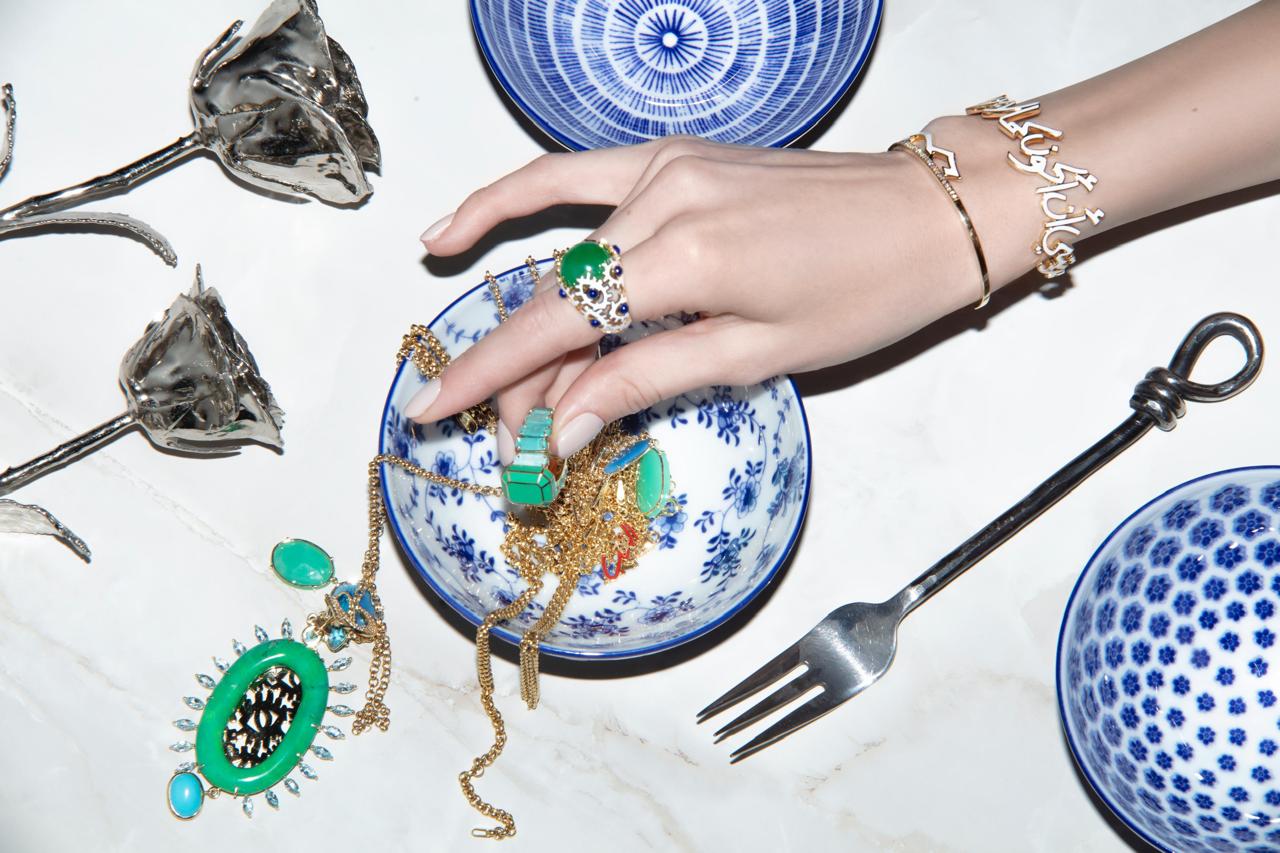
This month’s guest felt like a particularly relevant fit for this regional moment. Photographer and jewellery designer Nadine Kanso’s Bil Arabi is approaching its 20th anniversary, having built a distinctly eye-catching modern jewellery brand with Arab calligraphy at the core of its designs. The cultural and pop-forward nature of her work has notably brought her recognition beyond the region, including Forbes Middle East’s choosing her among the region’s most influential Fashion Innovators. Her collaborations have included international names such as Berluti and Guerlain.
Nadine is one of the many women entrepreneurs in the region I have been wanting to exchange with, but, like only a few others, she’s been in the game long enough to make her experience important for anyone trying to understand some of the dynamics of this region. Especially for those of us seeing things from a Western end of things, with all the changing but still solid misconceptions about women in the region.
I first met Nadine in 2021, during a memorable trip to Dubai marking my collaboration with Iwan Maktabi and Dubai Expo 2020. Her chic cigar smoking fashion forward allure can be intimidating but a few interactions reveal a warm, sharp and incredibly generous character. A Lebanese-born woman who became part of Dubai’s creative scene early on, she has witnessed the city’s extraordinary transformation from within. I have tried to craft questions that will hopefully reveal what it is like to be a lasting woman entrepreneur in the UAE, and how things have evolved over the past twenty years.
How are you, habebti (colloquial Egyptian for darling) Nadine, after this much tumultuous year in the region?
I have always chosen to look at life with the glass half full rather than half empty. Despite the difficulties this year has brought, I feel we have managed things well and continued to move forward. It has also given me the space to reflect on twenty years of Bil Arabi, why I started, what we have built, and what it means to continue creating from this part of the world. Reaching this milestone makes me even more determined to keep going with purpose, staying true to our vision while looking ahead to what comes next.
When and why did you move to Dubai?
I moved to Dubai 26 years ago, after living in Montreal and Prague due to my husband’s work. Before that, I grew up in Beirut, where I also attended university and where so much of who I am today was shaped. My upbringing remains a fundamental part of my identity. I carry the language, visual culture, contradictions and emotional richness of the Arab world with me, and they continue to inform the way I see the world and approach my work.
How do you approach your jewellery collections? Can you share some of the context behind this process in this process-obsessed day and age?
For me, the starting point is usually a word, a letter, or a feeling. I think about what it carries: its meaning, its emotional weight, and the memories or associations people might have with it. Then I begin exploring how that meaning can become a form, and how the calligraphy can live on the body as jewelry. Instinct is important. So are material, proportion, craftsmanship and wearability. The challenge is to make something that feels contemporary and beautifully made, while allowing the Arabic language to remain at the heart of the design.
You have described Meen Ana (“Who Am I?”), your 2006 photography project, as a work about Arab identity, created partly in response to the way Arabs were being perceived after 9/11. You then moved that question from photography onto the body through jewelry with Bil Arabi. Do you still consider Bil Arabi fundamentally an artistic project about identity, or has it become something different through the process of becoming a business?
Identity was at the heart of Meen Ana, and it remains at the heart of Bil Arabi. With photography, I was exploring how we see ourselves and how we are seen.
With jewelry, I wanted to take that question a step further: to wear my identity, quite literally, and to make Arabic language something personal and visible.
Over time, Bil Arabi has grown beyond a jewellery brand into a cultural movement, creating a space for Arabic language, identity and heritage to be expressed in a contemporary way. While building a business has brought its own responsibilities, the essence of Bil Arabi has remained the same: to celebrate our language, make it visible, and give people a way to express their identity through what they wear. Ultimately, it is about creating something that carries meaning, both culturally and personally, for every person who wears it.
Has success allowed your artistic practice to reach a larger audience, or has the success of the brand eclipsed the artist behind it?
I believe the two have always complemented each other. Building Bil Arabi has allowed the ideas behind my artistic practice to reach a much wider audience, while my work as an artist continues to inform and enrich the brand. Photography, jewellery and calligraphy are all different ways for me to explore identity, language and self-expression. They are deeply interconnected, each bringing a different dimension to the same vision. As Bil Arabi continues to grow, I see this relationship as an essential part of what makes the brand meaningful and allows it to keep evolving.
To first think in very broad strokes, do you think Arab culture, in comparison for example with European culture, has become fashionable? We’ve been witnessing a growing awareness of the importance of local heritage all around the globe. Would you say the world has genuinely become more receptive to Arab identity, both outside and inside the Arab region, meaning countries where Arabic is the first language? Asking this question, I think of how I felt compelled to mention Berluti and Guerlain in my introduction, even though you’ve collaborated with Arab brands as well.
There is certainly more attention on Arab culture, and I think that creates opportunities for more nuanced stories to be heard. But I would be careful about describing culture itself as a fashion. Culture is not a trend; it is lived, layered and constantly evolving. The important question is whether the interest goes beyond the visual and engages with the people, language, history and meaning behind it.
I do think audiences are increasingly open to seeing Arabic identity expressed in contemporary ways, both within the region and internationally. There is also a growing confidence in looking at our own heritage as something alive, not something that belongs only to the past. Collaborations with international houses can bring the work to new audiences, while collaborations with Arab partners are equally important. One does not validate the other. What matters is that the exchange is genuine and that the work retains its integrity.
What misconceptions about Arab women do you think exist within the Arab world itself?
One misconception is that Arab women can be described as one story. We come from different countries, families, generations and circumstances, and we have different ambitions and ways of expressing ourselves. Another is that there is a no single correct way to be modern, successful or connected to your culture.
For me, identity does not have to be a choice between heritage and individuality. You can be rooted in where you come from and still define yourself on your own terms. I think it is important to make room for that complexity, and to let women speak for themselves rather than having their stories decided for them.
What did the city allow you to do then that is harder to do now, and what does it make possible today that was unimaginable in 2006?
When I started Bil Arabi in 2006, there was more room to experiment in a landscape that was still developing. You could introduce an idea that did not fit neatly into an existing category and see where it might lead. Today, Dubai has a much more developed creative ecosystem, with greater visibility, access to talent, platforms and international audiences.
The other side is that the landscape is more crowded, and attention is harder to hold. But the possibilities are also much bigger. A concept can travel across markets and reach people around the world. The challenge now is not simply to be seen; it is to build something with enough meaning and integrity to last.
Do you think the framing of the “successful Arab woman entrepreneur” is itself reductive? And has being a woman actually shaped how you built Bil Arabi, or is that something others (like me, now) have imposed on your story?
It can be reductive if it turns a person into a category before looking at the work. I am a woman, an Arab, an artist and a founder, but none of those labels on its own explains the decisions, risks, failures or persistence involved in building Bil Arabi. Of course, being a woman shapes how you move through the world, and it would be unrealistic to say it has had no effect on my experience. But I would not want it to become the only lens through which the work is understood. I would rather the conversation make space for the complexity of building a creative business, and for the work itself.
After growing organically, without a business plan, how much of Bil Arabi is still driven by instinct and personal conviction, and how much now requires discipline, structure and compromise?
Instinct and personal conviction are still the starting point. Bil Arabi grew from a very personal idea, and I think that is part of what gives it its identity. But as the brand has grown, instinct alone is not enough. You need structure, planning, a strong team and the discipline to deliver consistently.
For me, the balance is knowing what can evolve and what cannot be compromised. The way we communicate, produce or reach an audience may change; the meaning and quality behind the work have to remain as is. Structure should help protect the original vision, not dilute it.
How do you see yourself and Bil Arabi going in the future?
I want Bil Arabi to continue evolving without losing the reason how it began. We are at twenty years, and that feels less like a conclusion than an opportunity to look at the work with fresh eyes. I want us to keep exploring calligraphy through design and craftsmanship, and to bring that story to more people and places around the world.
RAPID ROUND
Name a song
“Oudak Rannan” (عودك رنان) Ziad Rahbani
Name a dish
Tabouleh
Name a book
1984 – George Orwell
Name a country
Lebanon
Name a movie
The Godfather
Name a jeweller
Taffin
Name a word
Hobb / حبّ
Name a cigar
Trinidad
Name a perfume
Guerlain – Rêve d’amour
Name a cultural figure
Umm Kulthum
Thank you Nadine and Happy 20th anniversary Bil Arabi!
Omar
For more on Nadine Kanso’s Bil Arabi visit the website:
www.bilarabi.com